
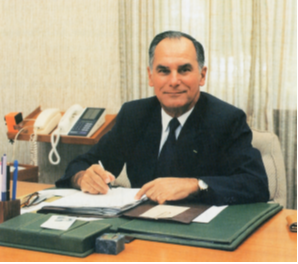
Dr Claude Ricaud passed away peacefully on Sunday 1 March, 2026 after a brief illness. Born on 9 February 1935 in Beau Bassin, Mauritius, he was the youngest of a family of 9 including 6 sisters.
After his secondary schooling at the Royal College of Curepipe in Mauritius, he joined the Mauritius Sugar Industry Research Institute (MSIRI) in 1956 where he devoted his entire career of 40 years until February 1995. As a laboratory assistant in the Pathology division, he first learned the profession from Prof. Robert Antoine, the Head, who instilled in him a lifelong passion for scientific research. During his early years, the diseases of the sugar cane that caught his attention were chlorotic streak and ratoon stunting which were causing significant yield losses in sugar cane in Mauritius and other parts of the world.
He simultaneously pursued his university studies and obtained a BSc degree in science from the University of London in 1958, as an external student, which earned him a scholarship for a post-graduate diploma (DIC) at the prestigious Imperial College of Science and Technology of the University of London in 1960. Benefiting from a scholarship from the British Council, he chose the same institution in 1964 for a master’s degree. His work proved so original that after additional research, Imperial College awarded him a doctorate (PhD) instead of a master’s degree, an exceedingly rare achievement, indicating his stature as a high-level researcher.
His formal studies completed, he devoted all his time to research on cane diseases including gumming, leaf scald, yellow spot, rust and other minor diseases. His work led to significant advances in the understanding of these diseases as well as their diagnosis and control methods.
Dr Ricaud climbed up the ranks: he was promoted to Assistant Pathologist in 1960, Associate Pathologist in 1965, Head of the Division of Pathology in 1969, Senior Scientific Officer in 1978, and Deputy Director in 1980.
During the 1970s, MSIRI’s mandate was extended to cover food crops such as potato, tomato, maize and groundnut. As was the case with sugar cane, Dr. Ricaud contributed to controlling the diseases that were inducing severe losses in these crops, notably late blight and potato bacterial wilt. One of his achievements was the establishment of a healthy seed production system for potato in tropical environments, at low altitude, an accomplishment as it is a temperate crop originating from the Andes in Peru.
Dr. Ricaud forged a reputation beyond the borders of Mauritius through his 177 publications. His work was published internationally, especially in the proceedings of the congresses of the International Society of Sugar Cane Technologists (ISSCT). His expertise was requested by various sugar companies in Africa, particularly in Tanzania. He had a vast knowledge of the sugar world through his trips in many countries.
In 1984, he was appointed Director of MSIRI. The most salient features of his mandate were the initiation and implementation of projects entrusted to the institute and financed by the World Bank as part of the sugar industry restructuring plan. He paved the way for the creation of an economic unit that gained momentum and was elevated to divisional status in 1991. In addition, Dr. Ricaud had a very keen interest in information technologies and promoted amongst others the development and use of geographic information systems for research at the Institute.
Dr. Ricaud was an active member of the ISSCT since the 1970s. He held numerous positions including: Chair of the Pathology Section at the XVI Congress in 1974 in Brazil and at the XVIII Congress in 1983 in Cuba, Chair of the Standing Committee for Sugar Cane Diseases from 1977 to 1983, Editor in Chief of the Sugar Cane Pathologists’ Newsletter from 1978 to 1980, Chair of the editorial committee for the revision of the ISSCT book on major diseases of sugar cane from 1977 to 1989, Councillor for Mauritius from 1985 to 1992, Vice-Chair of the Executive Committee, and Chair of the Technical Coordination Committee from 1992 to 1995.
The ISSCT established in 1924, had no permanent structure and it was decided at the XXII Congress in Colombia in 1995 to provide the organization with a Secretariat. Upon his retirement from MSIRI, Dr. Ricaud was appointed Permanent Secretary of the ISSCT, a position he held until August 2007 when he withdrew from his professional activities.
Dr. Ricaud also contributed to the advancement of the University of Mauritius by giving courses in Plant Pathology at the School of Agriculture and was a Member of the Senate from 1970 to 1975.
Dr. Ricaud’s activities were not limited to research and the academic field. He was Director of the National Economic and Social Council (NESC). He played an important role in learned societies such as the Société Agricole et Sucrière de Maurice (STASM) and the Royal Society of Arts and Sciences of Mauritius (RSAS), organizations of which he was the President after having held various positions. He was also a Fellow of the Mauritius Academy of Science and Technology (MAST). Similarly, he became interested in the Orchid Society of Mauritius and other social organizations. Athletic by nature, he enjoyed playing football and tennis. For many years, he devoted himself daily to walking.
In recognition of his contributions to scientific research and to the advancement of various organizations, several distinctions were conferred on Dr. Ricaud during his career. He was an Honorary Professor of the University of Mauritius and a Fellow of the UK Institute of Biology. The MSIRI silver medal was awarded to him during the Silver Jubilee in 1978 and the gold medal during the Golden Jubilee in 2003. He was appointed an Honorary Life Member of the ISSCT in 2005, Chevalier de l’Ordre du Mérite Agricole by the French President François Mitterrand in 1990 and Commander of the Most Excellent Order of the British Empire (CBE) by Her Majesty Queen Elizabeth II in 1991. These various distinctions, and others, illustrate the remarkable journey of the renowned scientist that was Dr. Ricaud.
Dr Ricaud married Eileen Thatcher in 1961, and from this union which lasted 53 years, were born Bianca, Béatrice and Daniel. To them and their families, we express our deepest sympathy. May they find, at the heart of their sadness, comfort in the precious legacy left to them by Dr. Ricaud: that of a devoted father, a loving grandfather and also that of a great scientist.
Jean Claude Autrey
General Secretary